
Africa’s digital economy is rapidly growing, fueled by digital transformation across the continent. Increased investments in cloud services, e-commerce, and digital financial operations are driving a surge in data centre development, with countries like South Africa, Nigeria, and Kenya leading the way. However, a key challenge remains: sustainable and reliable power systems must form the backbone of Africa’s digital expansion to ensure long-term success.
Overcoming the Reliability Barrier
Sy Gourrah, Divisional CEO at ACTOM Electrical Equipment, states, “Many regions in Africa still struggle with unstable power supplies. For instance, Nigeria’s power grid relies heavily on diesel generators during outages, while South Africa used to face load shedding. Data centres, however, demand near-absolute reliability, as any interruption can lead to operational failures. Fortunately, there are solutions. Data centre operators can achieve high reliability through duplicate power circuits, robust backup systems, and advanced monitoring technologies that ensure continuous operation despite grid instability.”
Fusing Reliability with Sustainability
Global and local data centre developers now face the challenge of creating facilities that are both reliable and environmentally responsible. Sole reliance on diesel power is no longer viable due to high operational costs and environmental concerns. Instead, hybrid power systems that combine renewable energy sources, such as solar and wind, with battery storage are being widely adopted. These systems reduce dependence on diesel generators, ensuring a reliable power supply while adhering to international environmental standards.
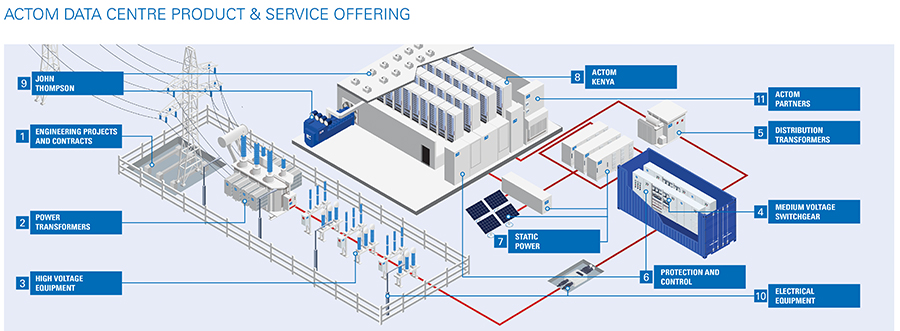
Herman Mare, General Manager at ACTOM Smart Technologies, adds, “While diesel generators remain essential as backups, excessive reliance on them presents operational and environmental risks. Their use contributes to environmental damage, incurs high costs, and fails to meet global sustainability targets. Transitioning to renewable energy systems with storage solutions can provide reliable power, minimise environmental impacts, and attract environmentally conscious investors.”
Urban vs. Rural Challenges
The physical characteristics of different locations also pose challenges that influence power infrastructure design. Urban areas benefit from proximity to substations and telecommunications infrastructure, making them ideal for large data centres despite higher electricity rates. In contrast, rural regions, which offer ample land and lower land costs, face limitations with power transmission. These challenges require investment in new substations, transmission lines, and microgrid systems, which are proving effective in supporting rural data centres of various sizes.
Gourrah notes, “South Africa is exploring energy wheeling practices to enable energy transmission between locations, while Kenya’s deployment of hybrid microgrids is providing reliable power to underserved areas. These advancements help tackle regulatory ambiguities and create resilient, sustainable power solutions.”
Enhancing Competitiveness
High electricity costs are a barrier to Africa’s competitiveness in the digital economy. However, the continent’s vast land resources and abundant renewable energy sources present significant advantages, positioning Africa as an attractive destination for investors seeking large-scale data centre projects.
Mare concludes, “Long-term infrastructure development is crucial for Africa’s digital future. Strategic investments in transmission networks, substations, and renewable energy systems will create a resilient foundation that supports growth for decades. The decisions made today will shape Africa’s global standing in digital infrastructure, ensuring it remains competitive well into the future.”